Can you install new siding over old siding? The short answer is NO!
Downtown in Freak Alley, painting straight over last year’s mural is the whole tradition. Your exterior walls are not Freak Alley. You can install new siding over old siding, technically, and we talk most people out of it inside ten minutes. The reason has nothing to do with selling more labor and everything to do with a tape measure. In 80 seconds, you will know which quote to trust.
Across Boise and the Treasure Valley, homeowners ask us this question when siding replacement quotes start coming in. The idea sounds reasonable enough. Leave what’s already there, skip the demolition, save some money. But on homes in Meridian, Nampa, Eagle, and the surrounding valley, the condition of what’s underneath matters a lot more than the layer everybody sees.
Can You Install New Siding Over Old Siding Legally in Boise, Idaho?
Yes. Nobody is going to arrest you, and plenty of valley houses are wearing two layers right now.
The IRC does not explicitly prohibit it. What the code insists on is that the finished wall still functions as a weather-resistant envelope under R703.1, and that a compliant water-resistive barrier sits behind the new cladding per R703.2, which in practice means a fresh barrier goes over the old siding before anything else happens. New flashing at every window and door too, integrated with that new barrier, even though perfectly good old flashing is already buried under there doing nothing for anybody.
Local permit requirements and adopted building codes can vary between Boise, Meridian, Nampa, Caldwell, and unincorporated Ada or Canyon County. A method that works on paper still has to meet the requirements of the jurisdiction where the house sits.
So the cheap quote is legal. Whether it includes the barrier, the furring, the longer fasteners, and the new flashing is a different question, and that question is usually where the savings came from.
The Fastener Math That Ends Most Boise Siding Go-Over Jobs
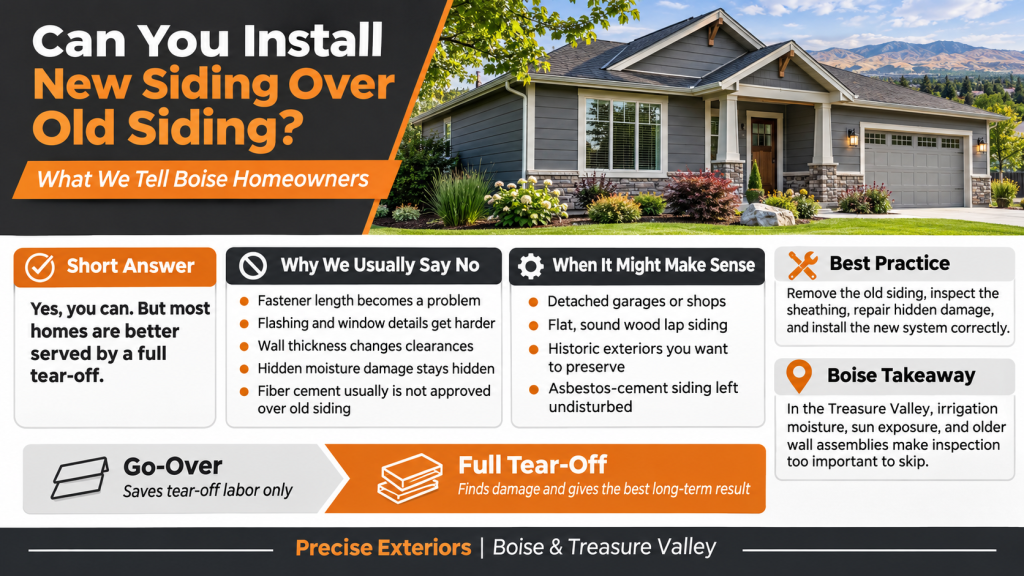
Read the spec sheet before the sales pitch. Vinyl siding fasteners must penetrate at least 1 1/4 inches into nailable material, and foam sheathing thickness does not count toward that figure.
Now run the arithmetic. Existing bevel siding eats maybe three quarters of an inch. Flattening a ribbed or irregular old surface takes furring, call it another half inch. You have burned an inch and a quarter before the fastener touches anything structural, which leaves a standard nail hanging in old wood and optimism.
Longer fasteners solve it, and longer fasteners are cheap. Somebody has to think of them, specify them, and actually buy them, though, and that somebody is rarely the crew that came in a thousand dollars under everyone else.
We run into this question on older homes across Boise, Caldwell, and Nampa, where original wood siding may have been installed decades before today’s replacement materials were even considered. The wall underneath was never designed with another inch of exterior cladding in mind.
What an Extra Inch of Siding Does to Windows, Flashing, and Roof Lines
Houses are built with deliberate gaps, and those gaps do real work even though nothing rests on them.
James Hardie’s own instructions want 1 to 2 inches of clearance between roofing and the bottom edge of siding and trim, a quarter inch at horizontal flashing left purposely uncaulked, 1 to 2 inches at decks, paths and driveways, and at least an inch between gutter end caps and the siding. Those are drainage gaps. Add a layer of cladding and every one of them shrinks by precisely the thickness you added.
Then the window problem, which is the one that actually leaks. New siding now stands proud of the existing window flange, so either the trim gets extended out to meet it or the siding dies into the side of the window with nowhere for water to exit. We have taken apart go-over jobs where new siding was lapped over the top of the window head flashing, which turns a drainage detail into a funnel. Water has no opinion about how the siding looks. It follows geometry.
This matters on Treasure Valley homes with complicated rooflines, especially where gables, dormers, and covered patios create extra intersections between siding and roofing. In Boise and Eagle, those details can make an otherwise straightforward siding project considerably less straightforward.
Vinyl vs. Fiber Cement: Which Siding Can Go Over Old Siding in Idaho?
Vinyl is the forgiving one, assuming the prep happens. Its installation manual is blunt about the two steps people skip: check every wall for evenness and furr where needed, and do not install vinyl siding over rotting wood. Loose boards get nailed down. Rotten ones come out.
Fiber cement is a harder no. HardiePlank’s instructions name the approved substrates and the list is short: braced wood or steel studs at a maximum of 24 inches on center, direct to OSB sheathing of at least 7/16 inch, or over foam up to an inch thick. Existing lap siding appears nowhere on it. The same document notes in capital letters that failing to install per the written instructions can VOID THE PRODUCT ONLY WARRANTY, and states plainly that James Hardie assumes no responsibility for water infiltration.
Sit with that one for a second. The most popular siding in the Treasure Valley comes from a manufacturer that has never blessed the shortcut.
And Idaho weather does not make that shortcut any more attractive. Between triple-digit summer afternoons, freezing winter nights, and the expansion and contraction that follows, siding on homes in Meridian, Kuna, and Mountain Home has enough to deal with before somebody adds an installation method the manufacturer never approved.
How Existing Siding Materials Affect Boise-Area Siding Replacement
Not all old siding presents the same substrate problem.
Flat wood lap is the friendliest case, because furring sits on it predictably. T1-11 and board-and-batten get harder, since grooves and battens force the furring to bridge an uneven plane and every fastener length turns into a guess. Cedar shakes are worse again: tapered, overlapping, impossible to flatten without a full layer of new sheathing, at which point you have paid for sheathing and still own the shakes. Stucco is its own conversation and usually ends in removal anyway.
You can find all of these exterior materials across the Treasure Valley. Older Boise neighborhoods have plenty of wood siding, established Caldwell and Nampa homes often have multiple generations of exterior work, and newer subdivisions in Meridian and Kuna bring their own combinations of engineered wood, vinyl, and fiber cement.
One scenario changes the entire calculation. Siding on a home built before the 1980s can contain asbestos, and that gets tested before anybody picks up a pry bar. Where a test comes back positive, removal stops being a labor question and becomes regulated work, and covering can turn into the sensible route rather than the lazy one. We do not guess on this, and neither should anyone bidding your job.
The Hidden Siding Damage Boise Homeowners Miss Without a Tear-Off
Now the part that never appears on an estimate.
A re-side is the only occasion in roughly thirty years when anyone will see the bones of your walls. Strip the old siding and the sheathing is right there in daylight: every soft patch, every stain trailing down from a window corner, every stretch where a sprinkler has been working the same eighteen inches of wall since the house was new. One afternoon of looking and you know exactly what you own.
Cover it instead and you have sealed that information in, along with whatever was causing it. Moisture that rotted the bottom course does not quit because something new showed up in front of it. It carries on in the dark, under warranty, behind a wall that photographs beautifully from the street. The homeowners who call us angriest are never the ones who paid for tear-off.
This is especially relevant in the Treasure Valley, where irrigation systems can put more water against the bottom of a house than homeowners realize. A sprinkler head aimed at the siding in Eagle, Meridian, or South Nampa can do its damage all summer without a single rainstorm. Cover that wall without looking underneath and the problem stays exactly where it was.
New Siding Over Old Siding vs. Full Tear-Off: What Costs More in Boise?
| New siding over old siding | Full tear-off | |
|---|---|---|
| Labor saved | Removal and disposal only | None |
| Costs added back | New barrier, furring, longer fasteners, extended trim, new flashing | Dump fees |
| Wall thickness | Grows 3/4 to 1 1/4 inches | Unchanged |
| What you learn about the sheathing | Nothing | Everything |
| Fiber cement eligible | Generally no | Yes |
| Hidden damage | Sealed in | Found and priced |
The quiet problem with the cost comparison is how little actually gets saved. Removal and disposal is the only line that disappears, while the go-over adds back a barrier, furring, longer fasteners, extended trim and fresh flashing. Done correctly, the gap between the two narrows to a rounding error. Quotes that stay dramatically cheaper stay cheaper by leaving things out.
Two layers complicate everything that comes afterward, as well. Future repairs mean working through twice the material, a home inspector will flag the double layer during your sale, and the next owner inherits a wall that nobody has ever actually looked at.
That last point matters in Boise, Meridian, and Eagle, where homeowners often put serious money into exterior improvements before listing a property. Fresh siding can improve curb appeal, but buyers and inspectors still care about what’s underneath it.
Worth saying as well: if your walls turn out to be structurally sound, neither job may be the right spend. Repainting sound siding costs a fraction of either number and we will tell you when that is the call.
When Installing New Siding Over Old Siding Makes Sense in the Treasure Valley
We do say yes sometimes. The cases are narrow:
- A detached garage or shop where the walls are flat, the stakes are low, and nobody will lose sleep over a stain they never saw.
- Sound, flat wood lap siding with no soft spots anywhere, receiving insulated vinyl, with the barrier, furring, fasteners and flashing all genuinely budgeted rather than assumed.
- A historic exterior somebody wants preserved instead of demolished, where covering is reversible and the original stays intact underneath.
- A rental being held for a short window before sale or redevelopment, by an owner who knows precisely what they are choosing not to find out.
- A wall where testing confirmed asbestos-cement siding and the abatement guidance you were given points toward leaving it undisturbed.
You see situations like these throughout Southwest Idaho, from detached shops on larger Kuna and Mountain Home properties to older Boise homes where preserving the original exterior is part of the conversation. The building, the existing material, and the owner’s plans all change the answer.
Notice what every one of those has in common. The owner made an informed decision about hidden damage. They did not have the decision made for them by whoever submitted the lowest bid.
Need New Siding in Boise or Meridian? The Cheapest Job Is the One You Only Do Once
Ask every bidder the same question and listen to how quickly they answer: are you removing the old siding, and if not, where exactly do the new water barrier and flashing go? Anyone who has thought it through will walk you through the barrier, the furring, the fastener length and the trim extensions without prompting. Anyone who has not will tell you the old siding adds insulation.
Our crews are our own people, not subs, and we will pull a board on your worst-looking wall before anybody writes a number down, because installing new siding over old siding is a decision that deserves evidence instead of a guess. Call Precise Exteriors at 208-901-4839. If the sheathing underneath turns out clean, we will say so, and your quote gets cheaper.
Precise Exteriors helps homeowners throughout Boise, Meridian, Nampa, Eagle, Kuna, Caldwell, Mountain Home, and the surrounding Treasure Valley make that decision before the first new siding panel goes up. Whether your home needs a complete tear-off, targeted siding repairs, or nothing more than fresh exterior paint, we would rather show you what the wall actually needs than sell you a shortcut that costs more later.