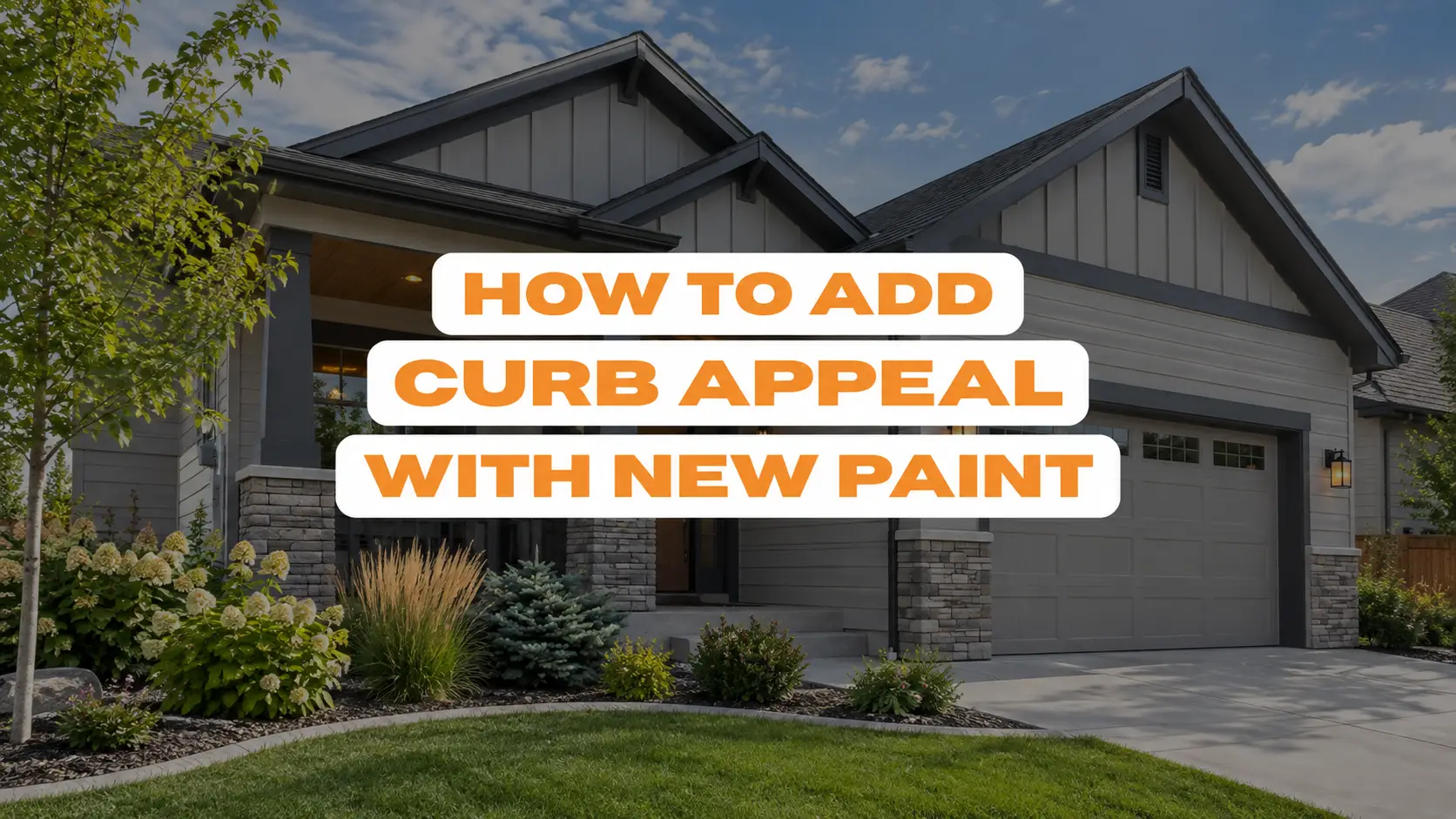
Can new exterior paint add curb appeal? The answer to that question is absolutely! New exterior paint will do a ton to update and modernize your Boise home in just a few days when you hire the right painting company!
Somewhere on your phone is a saved photo of a charcoal-black house with crisp white trim. Everyone has one. Moody exteriors have owned home design feeds for five years running and they genuinely look spectacular. They also carry a number most homeowners have never heard of, and under the Boise sun, that number quietly decides whether your paint still looks sharp in year eight or your siding warranty disappears in year two. Adding curb appeal with new exterior paint is the cheapest home improvement upgrade. Six decisions get you there without that particular regret.
Why Exterior Paint Delivers the Most Curb Appeal Per Dollar

Buyers form an opinion before the front door opens, and remodeling return data has reflected that unfairness for years. Exterior projects dominate the top of the list while expensive interior renovations sit near the bottom.
The math is mostly about denominators. Garage door replacement recouped roughly 268 percent of its cost in the 2025 Cost vs. Value Report and a steel entry door about 216 percent, because both started from a small number. Paint works the same way, covering the largest visible surface you own for a fraction of what replacing that surface would cost.
Paint carries one advantage the others do not. It changes everything at once. New siding transforms a house and costs accordingly. A well-chosen color scheme transforms the same house for a fraction of it, which is why we tell homeowners to exhaust the paint conversation before considering new siding.
What does LRV for Paint Mean?
Light Reflectance Value measures how much light a color bounces back, on a scale from 0 for absolute black to 100 for pure white. Ignore it and the consequences arrive slowly, then all at once.
Colors below 30 LRV absorb significantly more heat. That absorbed energy becomes thermal stress, and materials expand when hot and contract when cool. Repeat that cycle daily across Boise’s 120 to 130 freeze-thaw events a year and you get warping, cracking, and seal failures rather than a house that simply looks dark.
The warranty consequences catch people completely off guard. Most manufacturers of siding, doors, garage doors, and windows publish a minimum LRV for any paint applied to their products, frequently 55 or higher. Paint below that threshold and you can void the warranty entirely. CertainTeed maintains a separate warranty tier for colors under LRV 55. Vinyl siding distorts once surface temperatures pass roughly 165 to 175 degrees, which a low-LRV color on a west wall can absolutely reach here.
Worth knowing about how those claims actually pay out: manufacturers typically replace the material and not the labor, and labor runs 60 to 70 percent of a siding job. A voided warranty costs more than most homeowners assume.
The workaround exists. Sherwin-Williams VinylSafe pairs specific coating formulas with a curated palette holding a hard LRV floor of 55, keeping painted vinyl within roughly 8 to 12 degrees of the original factory color. If you want depth on a vinyl home, that program is the safe road.
Picking a Body Color That Holds Up in Boise Sun
Our light is unusually punishing. Boise sits near 2,730 feet, so homes here absorb roughly 10 to 15 percent more UV than they would at sea level, spread across more than 200 sunny days a year.
For sun-exposed regions, the general guidance points to LRV 55 or higher on the body, with the sweet spot for exterior work landing somewhere between 45 and 75. Below 45 in our climate, you are accepting faster fade and more thermal movement in exchange for drama.
Practical translation for a Treasure Valley home:
- Warm whites, greiges, and soft grays in the 60 to 75 range hold color well, hide chalking as pigment ages, and stay safely inside almost every manufacturer’s requirements.
- Mid-tone colors in the 45 to 60 range deliver real character while staying defensible. This is where most successful Boise repaints live.
- Deep charcoals and navies below 30 belong on accents rather than the whole body, unless you have confirmed the LRV requirement for your specific siding and are using a formula rated for it.
South and west elevations do the suffering. One wall of a Boise house routinely looks a decade older than the wall around the corner, so evaluate your color against the wall that takes the afternoon.
Where Color Actually Earns Its Money
Body color sets the tone. Smaller elements do the heavy lifting on curb appeal, and they cost almost nothing by comparison.
The front door is the single highest-impact square footage on your house. It is small enough that a bold, low-LRV color creates no thermal problem, and it is the one element visitors look at directly. Deep blues, blacks, and saturated greens all work here precisely because the surface is tiny.
The garage door occupies close to a third of what people see from the street on many Treasure Valley homes, and homeowners consistently forget it exists. Painting it to match the body makes it recede and the house read as larger. Painting it to contrast makes it a feature, which works when the door is attractive and backfires when it is not.
Trim frames everything. A crisp, higher-LRV trim against a mid-tone body produces the contrast that photographs well and reads as intentional. Trim also covers the elements that age worst here, so coordinate it with your soffit and fasciaand exterior trim rather than treating them as afterthoughts.
Gutters and downspouts are the detail that separates a professional result from a decent one. Painted to match trim or body, they disappear. Left mismatched, they draw the eye to the least interesting part of your house. Homes getting new gutters alongside paint should coordinate both at once.
A workable ratio: roughly 60 percent body, 30 percent trim, 10 percent accent. Three colors total is plenty. Four starts looking busy from the curb, which is the only vantage point that matters for this project.
When Paint Is Not the Answer
One honest limit worth naming. Paint is a finish, not a repair. Siding that is cracked, cupping, rotted at the bottom course, or pulling away from the wall will look briefly better and fail on the same schedule it was already on. Fresh paint over failing material is the most expensive way to delay a decision whether you’re in Boise, Nampa, Star or nearby!
Walk the house before you commit. Press on the lowest course and around windows, look for soft spots and separated seams, and check whether anything has come loose. Sound material takes paint beautifully. Material at the end of its life wants replacing, and our guide to how long siding lasts covers how to tell the difference.
Choosing the Right Sheen for Each Surface
Sheen affects durability and appearance as much as color does, and it gets almost no attention.
| Surface | Recommended sheen | Reasoning |
|---|---|---|
| Body and siding | Satin or low-lustre | Reflects more light, resists dust buildup, cleans easily |
| Trim and fascia | Satin to semi-gloss | Crisper edge definition, stands up to weather |
| Front door | Semi-gloss | Highlights detail, handles handling |
| Soffits | Satin | Hides imperfection while staying washable |
Flat finishes deserve one caution in our climate. They retain more heat and chalk faster under sun exposure, so the low-sheen look that photographs beautifully in a magazine ages less gracefully on a west-facing Boise wall.
Testing Colors Before Anyone Paints
Never choose a color from a chip held indoors. High-desert light is intense and slightly different from what most color palettes were designed under, and undertones shift dramatically between a store fluorescent and a Boise afternoon.
Buy sample quarts and paint large swatches, at least two feet square, directly on the house. Put one on the south or west wall and one on the north, then look at all of them at three times: morning, mid-afternoon, and dusk. A greige that reads warm and welcoming at 9 a.m. can turn distinctly pink at 6 p.m., and you would rather discover that now.
Check your HOA covenants while the samples dry. Plenty of Treasure Valley subdivisions maintain approved palettes, and approval is considerably easier to obtain before the crew arrives than after.
Your House Is About to Look Expensive
Curb appeal with new exterior painting comes down to restraint and one number nobody puts on a mood board. Keep the body in a defensible LRV range, verify what your siding manufacturer requires before falling for anything dramatic, save bold color for the door where it costs you nothing, and coordinate the small metal parts everyone forgets.
Pick three colors, sample them big, and look at them in real Boise light at three different hours. If they still work at dusk on the west wall, you have found your scheme. Precise Exteriors handles exterior painting across Boise, Meridian, Nampa, Kuna, and the Treasure Valley with our own crew, and we are happy to check an LRV before you commit to it. Ask us and bring the photo from your phone. We have seen that house too.
FAQ About Curb Appeal:
1. Can new exterior paint improve curb appeal?
Yes. New exterior paint is one of the fastest ways to improve curb appeal because it changes the appearance of nearly every visible surface of your home at once. A coordinated body, trim, and accent color scheme can make an older Boise home look cleaner, newer, and more intentional without the cost of replacing the siding.
2. What exterior paint colors work best for Boise homes?
Warm whites, greiges, soft grays, and mid-tone colors are practical choices for Boise homes because they reflect more sunlight than very dark colors. Treasure Valley homeowners should also consider how a color looks on south- and west-facing walls, which typically receive the strongest afternoon sun.
3. What is LRV, and why does it matter for exterior paint?
LRV stands for Light Reflectance Value and measures how much light a paint color reflects on a scale from 0 to 100. Darker, low-LRV colors absorb more heat, which can increase thermal stress on siding and other exterior materials. Homeowners should check their siding manufacturer’s requirements before choosing a very dark exterior color.
4. Can you paint over old or damaged siding?
Painting is a good option when the existing siding is structurally sound, but paint will not repair cracked, warped, rotted, soft, or loose siding. If damage is present, it should be repaired or replaced before painting so the new finish has a solid surface and the underlying problem does not continue getting worse.
5. How should Boise homeowners test exterior paint colors?
Paint large sample sections directly on the house rather than relying on a small color chip. Check the samples in the morning, afternoon, and evening, and place at least one sample on a south- or west-facing wall. Boise’s intense sunlight can make undertones appear very different outside than they do inside a paint store.